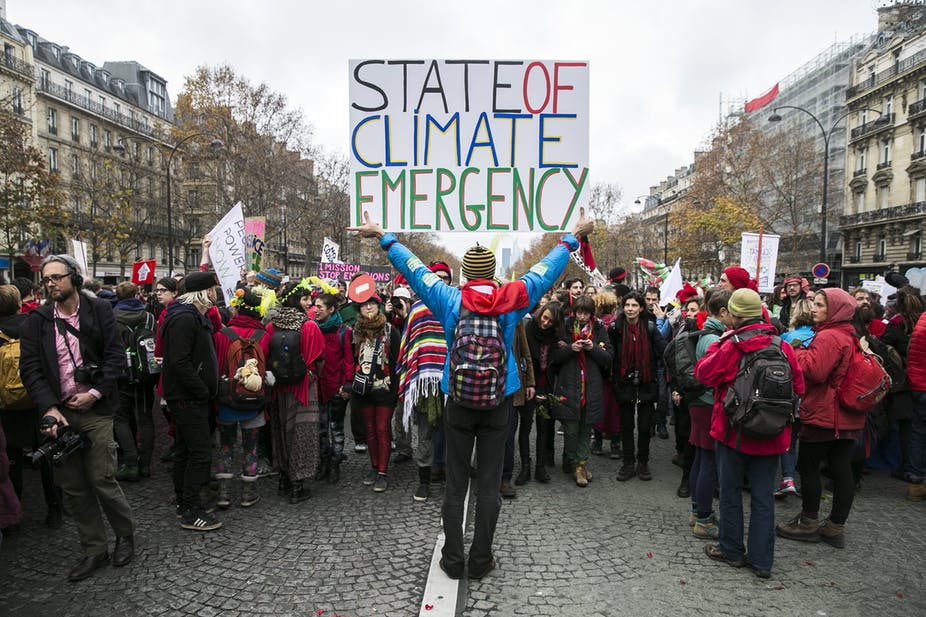
At the COP24 conference in Poland, countries are aiming to finalise the implementation plan for the 2015 Paris Agreement. The task has extra gravity in the wake of the recent IPCC report declaring that we have just 12 years to take the action needed to limit global warming to that infamous 1.5ᵒC target. Although the conference itself is open to selected state representatives only, many see the week as an opportunity to influence and define the climate action agenda for the coming year, with protests planned outside the conference halls. A crucial role of environmental activists is to shift the public discourse around climate change and to put pressure on state representatives to act boldly. COP24 offers a rare platform on which to drive a step change in the position of governments on climate change. However, many environmental movements in Europe are not offering the critical analysis and radical narratives needed to achieve a halt to climate change. Read more: Extinction Rebellion: I'm an academic embracing direct action to stop climate change
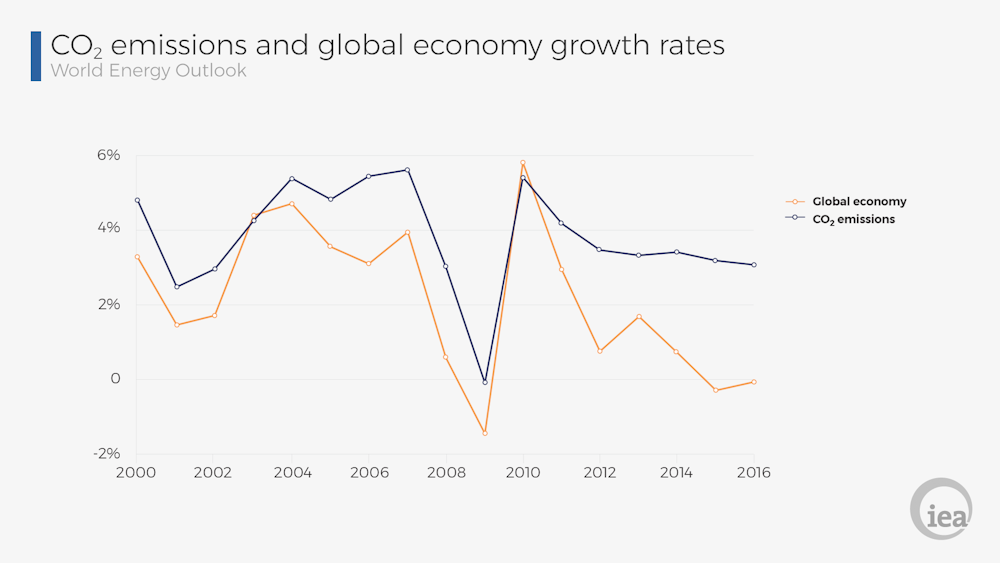 Economic growth and carbon emissions are closely linked. International Energy Agency
Practically, what this means is that as long as economic growth continues to expand rapidly and indefinitely, so too will the quantity of CO₂ in the atmosphere and the associated environmental and social impacts.
To address climate change, therefore, we must address the root cause of this planetary ailment: the ideology of growth first, growth always. By moving away from growth-oriented societies in Europe and other advanced economies, towards ones that prioritise environmental and social health, we stand the slimmest chance of solving our climate crisis, while still allowing the poorest economies globally to meet their economic needs.
Economic growth and carbon emissions are closely linked. International Energy Agency
Practically, what this means is that as long as economic growth continues to expand rapidly and indefinitely, so too will the quantity of CO₂ in the atmosphere and the associated environmental and social impacts.
To address climate change, therefore, we must address the root cause of this planetary ailment: the ideology of growth first, growth always. By moving away from growth-oriented societies in Europe and other advanced economies, towards ones that prioritise environmental and social health, we stand the slimmest chance of solving our climate crisis, while still allowing the poorest economies globally to meet their economic needs.

Anthropological thoughts on degrowth Degrowth energizes and interconnects remarkably heterodox thinking and surprisingly heterogeneous action. To advance dialogue among diverse pathways, a recent Journal of Political Ecology issue on “Degrowth, Culture and Power” joins studies of 15 initiatives to forge worlds that prioritize well-being, equity and sustainability rather than expansion. My intr...
As policy makers return from Marrakesh puzzling over what a Trump presidency means for the Paris agreement, it is fascinating and wonderful to watch, from a desk in one of the biggest anti-poverty and development organisations, the increased energy, depth, and passion of the degrowth movement. But this movement is unfortunately peripheral to many development conversations. Perhaps that is be...
Die Degrowth-Summerschule 2015 fand gemeinsam mit dem Klimacamp im Rheinland statt. Das Rheinland ist eines der größten Braunkohle-Abbaugebiete und die größte CO2-Quelle in Europa. Um gegen klimaschädliche Industrie und Ressourcenausbeutung zu protestieren, kamen hier verschiedene Bewegungen zusammen, um sich für Alternativen und eine soziale Transformation einzusetzen. Ein Video von Raute Film...